








by Almir Osmanović
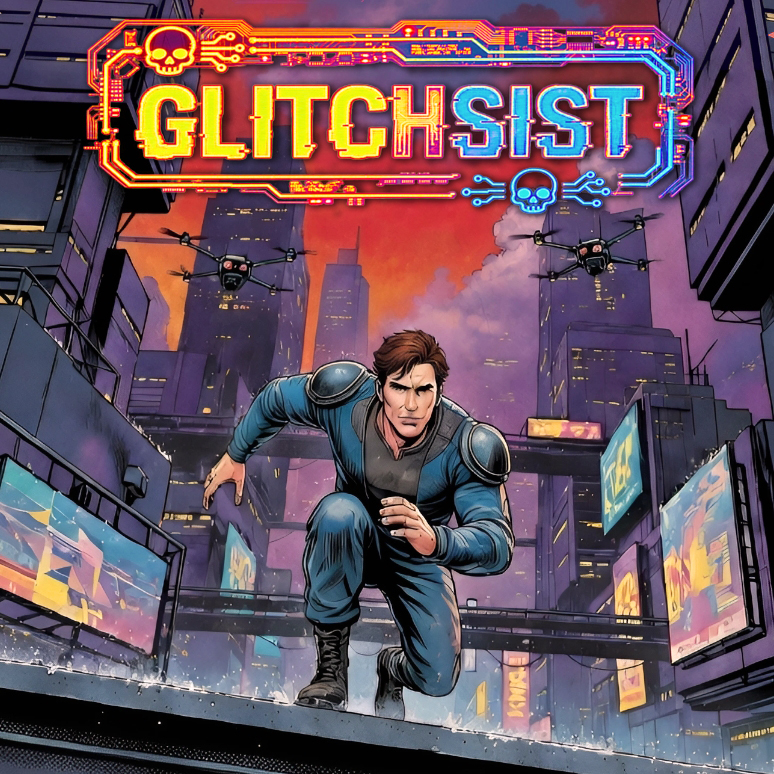
◆ Glitchsist was made and released by developer Tartessos Games for the ZX Spectrum 128k, running on a modified version of the well-known MK1 engine by The Mojon Twins. The creators successfully crafted a dystopian action-platformer set in a dark future drenched in neon lights and bleak landscapes. The story follows an operative who has infiltrated a powerful and corrupt megacorporation known as AOX Corp. Your mission is clear yet exceptionally dangerous: destroy the secret DELTA Project and free the trapped human consciousness that the corporation has subjected to total control.

The atmosphere is tense and claustrophobic as you fight your way through a heavily guarded industrial complex. The controls follow standard Spectrum layout, allowing play via keyboard or joystick. The audio makes full use of the AY-3-8912 chip found in Spectrum 128K. Throughout gameplay, you’re accompanied by a dark music track that heightens the overall sense of tension, though it gets a bit too repetitive. Sound effects for explosions and hits are pretty solid, giving players a satisfying feel during combat.


However, once you take a real look at what’s on the screen, you can see that Glitchsist suffers from serious issues that often ruin the overall experience and make the game frustrating. It’s a prime example of how ambition can outweigh technical skill and game design itself. While it catches your eye at first glance with its dark cyberpunk aesthetic, under the hood is a title at war with itself, testing the player’s patience.


The fighting mechanics are the weakest part of the game, with hit detection being extremely inaccurate. Quite often, you’ll swing at an enemy only to pass right through them, while they still manage to hurt you. Combat frequently devolves into mindless button-mashing in hopes of landing a hit before the enemy hits you. Shooting offers a bit of relief, but your firing angles are limited. Enemies attacking from specific angles or crouching are often unreachable until they get right up in your face. The controls, despite being touted as fluid, suffer from noticeable input lag, which is unforgivable in a high-difficulty game. Jumping over lethal pits requires pixel-perfect accuracy, and the main character’s stiffness upon landing often leads to instant death.


The game’s biggest issue is its level design and overall progression. The developers tried to build a complex industrial facility for AOX Corp, but the end result is a maze of screens that all look virtually identical. By the fourth or fifth screen, you already get the feeling you’re running in circles. Backgrounds and the color palette quickly get stale as the same patterns are constantly recycled. You’ll often have to fight your way through several tough screens packed with enemies just to flip a single switch, only to backtrack through the exact same route, unnecessarily padding out the game’s length and killing the pacing. Glitchsist isn’t hard in a fair way, it’s hard because the gameplay is poorly balanced. The game constantly punishes you the moment you step onto a new screen. Your character can spawn right in front of a bullet or an enemy, leaving you with literally zero time to react. On the other hand, the checkpoint placement is unforgiving. A single mistake can send you way back, forcing you to go through the same dull enemy patterns all over again.

◆ While it’s a nice touch that the game tries to minimize color clash, it does so by making characters and enemies mostly monochrome against a pitch-black background. Visually, this makes the game look clunkier than some titles released in the late 80s.
◆ When all is said and done, Glitchsist is an average homebrew project that unfortunately suffers from a few classic pitfalls of modern retro development.

You can download the game for free at the following link :
One response to “Glitchsist – ZX Spectrum | <mini review>”
-
Welcome!










Leave a Reply